

On this page
What is a RichAuto DSP motion controller?
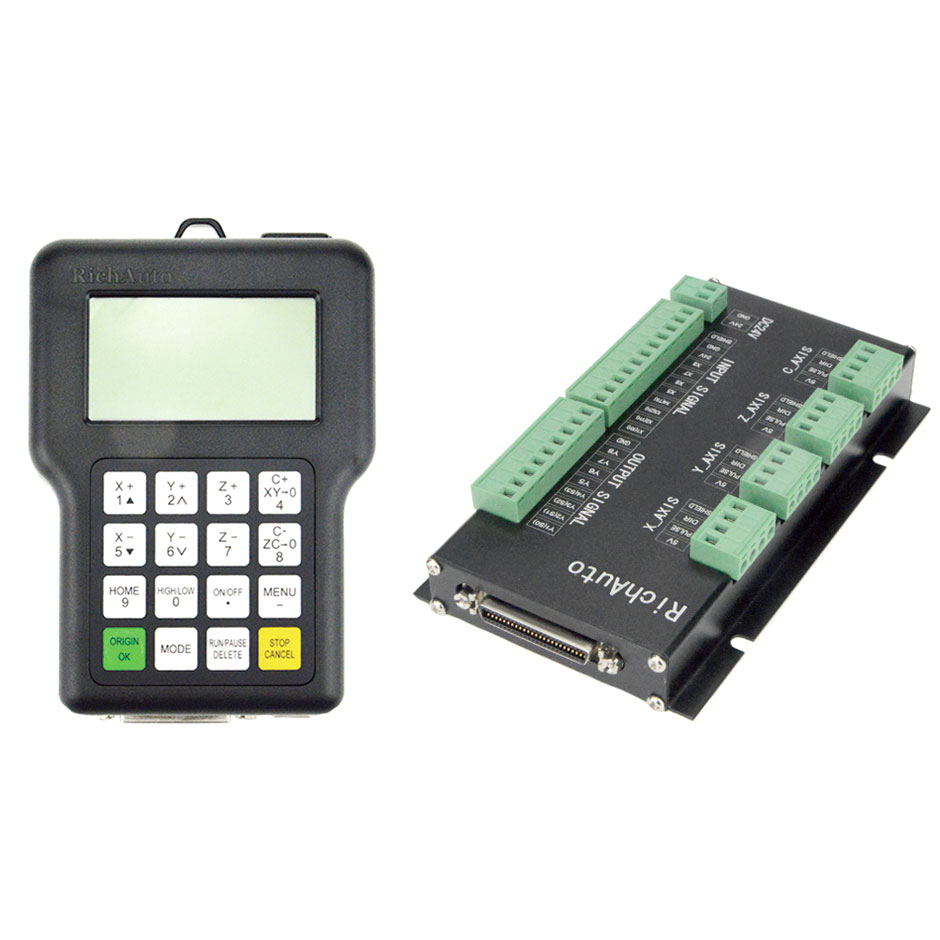
RichAuto DSP controllers are standalone handheld motion control systems widely deployed on CNC wood routers, stone engraving machines, and specialized milling tables.
Unlike PC-based CNC control architectures (such as Mach3 or LinuxCNC), a DSP controller handles real-time trajectory planning, step pulse generation, and I/O monitoring directly on an embedded high-speed processor. The system does not depend on a host computer during live machining.
Core system composition
A complete RichAuto CNC control package comprises three essential hardware modules:
- Handheld Pendant: Features a high-contrast industrial display, silicon tactile keypad, and USB interface for program loading and coordinate jogging.
- 50-pin Shielded Data Cable: High-density differential link designed for high noise immunity inside industrial machine cabinets.
- Interface Breakout Board: Connects directly to stepper/servo drivers, VFD spindle inverters, limit switches, and tool setters with optocoupler isolation.
Key series comparison
RichAuto classifies its motion controllers into distinct functional tiers:
1. A1X Series (Standard 3-Axis & 4-Axis)
The baseline series for standard cutting, carving, and relief machining:
- A11: Standard 3-axis motion with continuous linear and circular interpolation.
- A18: 4-axis simultaneous control, engineered specifically for rotary cylinders and A-axis carving paths.
2. B1X / B5X Series (Multi-Head & Cylinder Processing)
Upgraded industrial series offering expanded I/O and specialized spindle logic:
- B11 / B18: Enhanced memory and additional configurable digital inputs/outputs.
- B57 / B58: Advanced multi-spindle switching controller, capable of driving multiple independent spindles with pneumatic tool-shifting.
Selection and compatibility checklist
Before selecting or replacing a RichAuto DSP unit, verify the following machine parameters:
- Axis Topology: Confirm whether the machine is purely 3-axis (XYZ), dual-Y gantry, or true 4-axis (rotary).
- Drive Signal Requirements: Verify pulse and direction (PUL/DIR) signal voltage (5V differential vs. 24V single-ended).
- Spindle Control Interface: Confirm whether the VFD requires multi-step digital frequency control or 0-10V analog speed reference.
- Tool Sensor Type: Check whether tool setters and emergency stop buttons are normally open (NO) or normally closed (NC).